Structured Literacy
Individualized, multisensory reading and spelling instruction grounded in the Orton-Gillingham approach and evidence-informed literacy practice.
Integrative Education • Literacy • Curriculum Design
Evidence-informed literacy instruction, integrative curriculum design, and educational consultation grounded in development, inquiry, and intentional practice.
Elissa Gonzalez, M.Ed.
Integrative Educator Curriculum Designer Author
Bringing research, development, inquiry, and intentional design into coherent educational practice.
A Philosophy of Practice
Education is not the delivery of information. It is the deliberate design of experiences through which learning becomes possible.
That belief shapes every engagement — from individualized instruction to the design of entire curricula and learning environments. Elissa works at the intersection of research and practice, translating what we know about development and learning into conditions that preserve curiosity and agency while supporting integrative learning across contexts and disciplines.
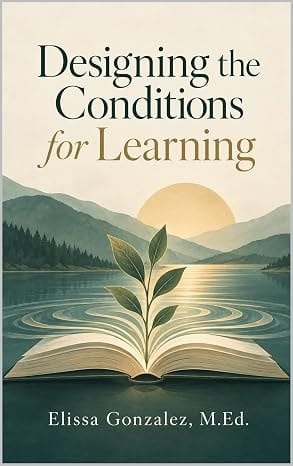
New Release
What if the most powerful teaching begins not with directing children's learning, but with designing the conditions that allow it to emerge?
By Elissa Gonzalez, M.Ed.
This book explores a different way of thinking about teaching—one that begins with curiosity, honors agency, and pays close attention to the environments, relationships, and experiences that shape learning. Grounded in research and lived educational practice, it invites educators to move beyond delivering instruction and toward creating the conditions in which deeper understanding, connection, and belonging can take root.
Explore the Book →What I Offer
Three areas of practice, unified by a shared design philosophy: understand the learner, attend to context, and design with intention.
Individualized, multisensory reading and spelling instruction grounded in the Orton-Gillingham approach and evidence-informed literacy practice.
Developmentally responsive curriculum and learning experiences shaped by inquiry, sequencing, environment, language, and learner variability.
Strategic consultation for families, schools, and organizations seeking stronger instructional practice, curriculum coherence, and learning environments.
Selected Work
The Approach
Featured Work
Where Wonder Takes Root.
Nature Nest is an early childhood environmental learning initiative developed by Elissa Gonzalez at Florida Atlantic University’s Pine Jog Environmental Education Center. Rooted in the understanding that stewardship is cultivated through relationship, the initiative invites young children into meaningful encounters with people, place, and the natural world. Through the integration of early childhood pedagogy and environmental education, Nature Nest creates the conditions for wonder, inquiry, connection, belonging, and the emergence of environmental stewardship.
Wonder begins with attention: children notice before they are asked to explain.
Discovery turns attention into inquiry through sensory investigation, play, movement, observation, and dialogue.
Connection emerges as children recognize relationships among living things, materials, environments, experiences, and themselves.
Belonging extends those relationships into identity, place attachment, care, and environmental agency.

About Elissa
Integrative Educator · Curriculum Designer · Author
Elissa's work sits at the intersection of structured literacy, early childhood education, curriculum design, experiential learning, and environmental education.
Her approach is grounded in the belief that curriculum is more than a sequence of activities. It is a designed ecology of experience, relationships, materials, environments, inquiry, educator intentionality, and place.
Her current scholarly trajectory includes plans to pursue doctoral study at Florida Atlantic University, with research interests in curriculum and instruction, early childhood environmental education, experiential learning, and the design of conditions that support child agency and meaningful learning.
Contact
Every engagement begins with a conversation. Meaningful learning emerges through intentional design.
Palm Beach County, Florida • Local + Virtual Collaborations